Showing posts with label infrastructure. Show all posts

Saturday, 25 February 2023

A Flyover to Nowhere


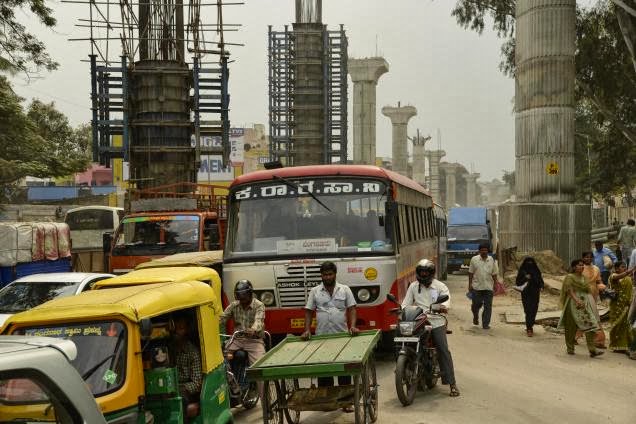
A cartoon is doing rounds on Twitter about two archaeologists in 3000 AD visiting the spot where the unfinished Ejipura to Kendriya Sadan flyover lies and wondering, “Nobody really understands why they were built.” The flyover has been in the making for over five years and even now nobody has any clue regarding its completion. It is a sore testimonial of the shortcomings in the execution of infrastructure projects. 

With the traffic volumes at Ejipura junction and the subsequent Sony Signal in Koramangala, where 100 Feet Road intersects the Inner Ring Road, witnessing an exponential increase, the then state government in 2014 decided to build a flyover to provide a signal-free traffic flow and decongest Koramangala.

Kolkata-based firm Simplex Infrastructure Limited was given the work order for the flyover and the work began in 2017. The motorists began feeling the heat when the middle section of the Inner Ring Road was barricaded with tin sheets to erect flyover pillars.

The carriage space got nearly halved and the travel time doubled for traversing between Ejipura junction and Sony Signal. During the evening peak hours, when the offices at Embassy Golf Links Technology Park near Domlur empty out, the six-lane Inner Ring road has four rows of cars moving in each direction, with two-wheelers snaking through whatever remaining space.

After the Ejipura signal, the jostle for restricted carriage space begins. Incessant honking, brinkmanship and big vehicle bullying smaller ones happen.

For Koramangala and Ejipura residents, the dust emanating from the pillar construction and the loud noise of earth movers and cranes disrupted their day-to-day life. Many had to keep their doors and windows permanently shut.

The first deadline was 2019, but like most infrastructure projects Simplex too failed to honour it. Hardly any eyebrows were raised and motorists on the Inner Ring Road went through their daily grind in a ‘grin and bear it’ mode.

However, what followed rattled even diehard sceptics. Simplex missed many more deadlines and the company’s mounting debts pushed its 28 lenders, including some prominent banks, to classify it as a ‘non-performing asset’ in 2020. The BBMP was left with no option but to terminate the contract.

Another stumbling block was transferring defence and private land for the flyover and clearance to cut trees. These issues have still not been resolved.

All work came to a grinding halt with the unfinished pillars standing out like sore thumbs. Earth movers and other movable assets soon disappeared, leaving behind the remnants of a half-finished flyover. The tin sheets put up as barricades were also subsequently removed.

This status quo has remained for over two years and these unfinished structures have gathered moss during monsoon and pose a hazard to motorists.

BBMP has been making efforts to kick-start the stalled project, but it has so far not been successful. The response to the fresh tenders in August last year was poor with only two firms participating and they too failed to qualify the eligibility criteria. Hence the flyover's fate continues to remain in limbo.

The effectiveness of flyovers in easing the traffic flow has been open to heated debate. They were initially seen as a magic wand as they helped vehicles move past the traffic jams, but the city planners soon realized that they merely shifted the snarl from one place to another and created new bottlenecks. Instead, transport experts moot that the policymakers should make public transport more effective and attractive to users to decongest the cities.

However, flyovers continue to find favour with the politician-contractor lobby as it means involvement of big money and kickbacks.

Also Read: Random Jottings


Thursday, 5 November 2015

Pipes On Footpath, Pedestrians Beware


A stroll down the pavement on HAL Airport Road from the airport entrance to Wind Tunnel road has now turned into an obstacle course with pedestrians often being forced to step on to the road and risk their lives. 

Like any other footpath in Namma Bengaluru, this one too had its share of broken and unsteady slabs, is encroached upon and gets 'run over' by bikers during rush hour traffic. But now pedestrians have to contend with a far more formidable challenge – cement pipes. 

Civic authorities have piled up giant pipes, mostly in a pyramidal formation, each about 20 feet long and having two feet diameter. These pipes are lying at various stretches of the footpath and occupy most of the space.

Hence that leaves the pedestrians with no option but to step on to the road and risk their lives, especially during office hours when for the motorists every inch counts.

While approaching the garbage collection point near Kemp Fort, one has to gingerly negotiate through the garbage residue and hold the breath to endure the everlasting stench. It becomes more acute when porakarmikas go on strike or those residing near the city’s landfills rise in protest.

If you happen to pass by when the garbage collection is in progress, with garbage trucks and autos parked on the side, you will be forced to walk right in the middle of the road with Volvo buses, autos and bikers breathing down your necks.

Next in line comes a bus shelter, which often doubles up as a restroom for cows, reminding the bus commuters of their cattle class status.  

Like most squatters these pipes too seem to be in for a long haul. They have been lying for nearly a month and looks like the authorities have almost forgotten about it. 

The pipes have already gathered a fair share of standard waste matter found on Indian streets - cigarette packets, liquor bottles, plastic tea cups, paper wrappers, tetra packs and plastic bags. Unless the civic authorities pull up their socks, dogs and bandicoots may soon start calling these pipes their home.

Also Read: Random Jottings


Thursday, 29 October 2015

Why Can't Manholes Be At Road Level?

The city may have earned many flattering monikers such as garden city, IT capital, start-up capital and the like, but when it comes to handling basic issues such as roads, drains, and power supply the city still seems stuck with 18th century methods and technology.

A look at the way manholes have been built on or near the roads is a case in point. They are rarely at the road level and some protrude almost one feet above the roads, posing danger to motorists during nights and when the streets get flooded due to rains.

I am no civic expert but I don’t understand why manholes cannot be built at road levels or why there is no uniform standard across the city. 

The manhole near the lane where I live is located on a gradient and stands nearly a foot above the road level. It is close to a storm water drain and further shrinks the width of an already narrow road. Motorists have to avoid it, thereby leaving space for only one four-wheeler to pass at a time. 

Thus the spot becomes a rite of passage for motorists, especially during peak hours, as they often indulge in brinkmanship to get the first chance to pass. Those coming down the gradient feel they have the divine right to pass first and those climbing the gradient too harbour the same sentiment with equal vigour. 

High decibel honking, angry gesticulation and even heated arguments break out and the traffic on narrow lane gets held up. This is a common scene around 9-10 am when people are rushing to work. And I am sure this is not an isolated case in the city. There may be many such manholes which stand out like sore thumbs and hamper traffic movements, thanks to shoddy workmanship.

Also Read: Random Jottings

Monday, 10 August 2015

Swachh Bengaluru? Houdaa!

Bangaloreans are rubbing their eyes in disbelief. Their city recently aced Swacch rankings - it has been adjudged 'cleanest' among state capitals in the country and has an all-India ranking of seven. However these impressive rankings drew more incredulous guffaws than elation.

A small minority did post 'congrats Bangalore' or 'proud to be Bangalorean' messages on social networking sites and for the Siddaramaiah Government this news must be a source of some comfort, as the city would soon have civic polls and the government's report card had more black marks than potholes on city roads. But for the majority of Namma Bengaluru residents it was as if they have been told that driving through Silk Board junction or K R Puram signal was as easy as a stroll in the Cubbon park.

Some felt this might be some silly mistake (maybe Bangalore is actually at the bottom of heap and misconstrued as being on top) or the survey has been totally manipulated. While others wondered if a city like Bangalore has earned such a distinction then what kind of hell holes other state capitals and cities in the country may be. The latter seems more plausible as the study was done to check on open defecation and solid waste management in municipal areas. They also assessed the drinking water quality, waste water management and the status of disposal of sewage from septic tanks.

Using the above markers the fact remains that even in the toniest neighbourhoods in Bangalore one is never away from heaps of garbage, at various stages of putrefaction, with dogs, crows and cows rummaging through it. Those carrying out the assessment either failed to see all this or they had little choice - other cities had even more hideous underbellies, notwithstanding toxic foaming lakes of Bellandur and Yemalur.

However what surprised me was that Hyderabad figured way down (ranked 275) the list, among some of the cow-belt towns synonymous with filth and squalour, which also  ensure that our social indicators remain rooted to  sub-Saharan levels. The city was the darling of most coffee table conversation in Bangalore. Whenever the topic of Bangalore's nightmarish traffic or poor infrastructure crops up, Hyderabad is often cited as an example Bangalore could follow.

Lastly the ugly fact remains that all the cities in our country are way too filthy, thanks to our poor civic sense, runaway population growth and long standing mismanagement by our city fathers.

Many cities in the world, most notably Singapore, which were filthier than ours few decade ago have metamorphosed into neat futuristic places, almost on par with European and North American cities. Whereas our cities seem to be regressing further and inspire little hope. They often figure prominently in surveys such as 'world's most polluted cities' and similar dubious distinctions.


Also Read: Random Jottings

Monday, 6 July 2015

Level Crossings: A Primer

It is a great leveller. It has the power to make every vehicle, no matter its size, the VIP quotient of its occupant or the nuisance value of its horn, painfully wait at its behest. In Bangalore city, railway level crossings at most places are a sore reminder of the deep rooted inertia and lack of foresight of our city planners in implementing alternatives such as overbridges or under passes.
 

Level crossings are a relic of an era when traffic volumes in the city were one tenth of what they are now. When every middle class family's nirvana was 'hamara Bajaj' and very few actually attained it. A waiting period of 4-5 years for a scooter was quite common. Things like EMI were not even heard of and 'easy finance' only meant dowry!
 

The scene near level crossings are of utter chaos driven by sick hurry of motorists, though a little patience and respect for order (something very foreign to our nature) would go a long way in making matters easier. As the gates tilt down to a close with the accompaniment of a buzzing sound, some bikers race to sneak through with the adeptness of movie stuntmen.
 

Once the gates are down the dreary wait for the train to pass begins, and so does the crafty jugaad mentality of motorists. Like rats and cockroaches those on two-wheelers manage to sneak past the waiting traffic, to be close to the gate so that they can scoot off the moment it opens. By the time the train arrives, the traffic build up on both sides is like rival armies arrayed in a battle formation, eagerly waiting for the war bugle to go off.
 

Once the gates are opened all driving etiquette take a back seat and Darwinian instincts take over. Size of the vehicle and number of wheels become crucial. Those steering burly six-wheeler trucks try to browbeat those behind the wheels of 800 cc hatchbacks and sedans into submission. Luggage auto rickshaws laden with steel rods intimidate two-wheeler riders by subjecting them to 'cheeky' close shaves.
 

For all motorists in general its a nerve wracking one-inch-at-a-time rite of passage as they have to maintain their cool amid high decibel horns, heated exchanges and brinkmanship by fellow motorists. By the time the chaos gets over, it's time to down the level crossing gates for the next train.
 

Tailpiece: Motorists should realise that it is mechanical energy that powers the gates of level crossings and not sound energy. Hence please give your thumb, 'horn' button and the battery a much needed break!

Also Read: Random Jottings

Sunday, 20 October 2013

Jottings on Mysore Road

Nearly five years back while driving down to Mysore the worst on the traffic front used to get over after scaling the BGS flyover, but now one has to reach Wonder La to come anywhere near the fifth gear. The BGS flyover now acts as a short interval before the going gets even tougher. Even inside the sturdiest of vehicles one gets a feel of venturing out on a small boat into the sea with cyclone Phailin for company. Mysore road is not for the faint hearts. The twin infrastructure mayhem of an under-construction Metro elevated rail and a flyover plus the volume of traffic cracks even the most composed and accomplished motorists.

Buried among these works are the numerous deadlines and assurances. The last one was by a minister who said the at least the roads in these stretches will be less taxing on the commuters' spinal  cords and vehicles' suspension by Dasara. The latest buzz is that it will be fixed before the proposed visit of Gujarat Chief Minister Narendra Modi as the ruling Congress party wants to avoid his barbs over city's infrastructure! Clearly the slight of a rival politician is more important than the agony of commuters who have to rough it out on these roads on a daily basis.
 

Whether it is a sign of rising population or growing empowerment, the number of speed breakers on the Bangalore-Mysore highway have risen dramatically. Earlier it used to be one speed breaker per municipality or taluk, but now it is one per panchayat or panchayat ward, which takes a toll on the pace. Lack of street lights makes life even more difficult for motorists plying in the night.
 

Cattle and bullock carts act as spokes to the journey. Somewhere between Ramanagaram and Channapatna we had a minor traffic jam - the reason? a bullock cart laden with fresh sugarcane crop had strayed into the wrong side of the divider. Hapless motorists could do little other than fume and honk while the cart ambled on the right side of the road. The bullocks and the cart driver were maintaining a zen-like composure, totally unmindful of the cacophony they had caused. Even the hyper-aggressive drivers of KSRTC buses and trucks had to grudgingly make way.
 

The cart guy wanted to go to a lane on the right side of the highway. However abiding by the traffic rules would have meant keeping to the left and taking a U-turn couple of kilometres down the highway - something quite alien to him. After all he needn't worry about  traffic police, fines, road tax or even fuel prices.
 

Some of the towns on the way have grown to become as crowded and chaotic like some Bangalore suburbs. The Mandya town with traffic signals, slow moving traffic and crowded junctions reminded me of BTM Layout.

Also Read: Random Jottings


Monday, 16 September 2013

Deconstructing Suranjan Das Road


Apart from the usual suspects – the civic officials and the contractors – the 4-5 kilometre long Suranjan Das Road, which provides a vital link between Old Madras Road and Old Airport Road, is also a conspiracy involving automobile mechanics, orthopedics and of course those offering quack remedies for neck and back pain. For the medical fraternity the road can be an ideal place to carry out experiments to determine the threshold limit of strain a human bone can be subjected to, before it reconciles to plasters.

In its monsoon glory the stretch near Gitanjali Layout resembles poor man's Venice. The road was meant to be four-laned, but now it has two lanes of antiquated concrete road and two lanes of mini-canal with nearly four-feet deep trenches all along. With the jurisdictional C V Raman Nagar MLA belonging to BJP and a Congress government at Vidhana Soudha, much water is expected to flow down these trenches before a four-lane road becomes a reality.

The stretch from the BEML Gate to HAL Aerospace Division has an uncanny knack of getting inundated with knee deep water, even if there is a 15-minute drizzle. During heavy rains it acquires the menacing ability to even make burly Tata Sumos gasp for breath, due to inundated exhaust pipes.

For those who wish to get a hang of what off-road racing is all about, but loath to drive all the way to the city outskirts, the stretch near the HAL vegetable market could be ideal to learn the basics.

Also Read: Random Jottings

Wednesday, 8 May 2013

Treating Garbage: Lessons From Oslo


The heat and dust of elections and the race to the gaddi at Vidhana Soudha may have pushed the city's garbage issue underground for now. But like a bad penny it cannot be wished away and its stench is only round the corner.

The much touted drive for waste segregation had met with limited success and is confined to few pockets. Deep seated habits like poor civic sense and caste prejudice, coupled with government's half-hearted measures have ensured that it is no way successful in mitigating the garbage pile ups that dot the city's street corners.

The other day I happened to read New York Times link forwarded by a friend on waste management done in the Norwegian capital Oslo. It was quite literally an eye opener. Oslo has a waste-to-energy incinearator on its outskirts and it turns garbage into heat and electricity. Roughly half the city and most of its schools are heated by burning garbage.

Households separate their garbage, putting food waste in green plastic bags, plastics in blue bags and glass elsewhere. The bags are handed out free at groceries and other stores. The plants uses computerised sensors to separate the color-coded garbage bags that race across conveyor belts and into incinerators.

Household trash, industrial waste, even toxic and dangerous waste from hospitals is grist to the incinerator. Its appetite is so huge that the city's garbage is just not enough and hence it is shipped in from faraway places such as England, Ireland and neighbouring Sweden to keep the plant running. It has even set sights on the American market.

And mind you Norway is no way starved of fossil fuel reserves. It is a major exporter of oil and gas, and has abundant coal reserves.

In fact the whole of North Europe has become a hub for waste to energy plants and Oslo is now facing tough competition from Swedish capital Stockholm. Environmentalists there fear that in order to keep these plants running people may be encouraged to produce more waste!

It holds an important lesson not just to Bangalore, but to whole of India. The country is urbanising at a brisk pace and even Tier 2 and 3 cities are feeling the pressures of overcrowding and strain on infrastructure. Already our cities are getting reduced to eyesores and badly need such innovative measures to treat garbage.

Moreover with most parts of the country are reeling under power cuts, the power generated by these units could lessen burden on our power plants and grids. It will also lessen the environmental cost in setting up a thermal or nuclear plant. And I am sure that in India raw materials will never be a problem for these garbage plants.

Also Read: Random Jottings