Tuesday, 28 August 2012

Biotech for Cleaner Lakes


Bangalore's 'pensioner's paradise' tag got buried under the numerous steel and glass structures, traffic gridlocks and dwindling tree cover and the city acquired a new avatar of being India's very own silicon valley. Software movers and shakers such as NR Narayana Murthy and Azim Premji became household names.

However the biotechnology sector, though quite active in the city, somehow got eclipsed and could not come out of the shadows of IT sector. For those not studying biotechnology, their familiarity with the sector begins and ends with Biocon and its chief Kiran Mazumdar Shaw.

Ever heard of Nualgi Nano Biotech (NNB)? A chance encounter on NDTV site about this company made me sit up and watch. This Jayanagar-based biotech firm is helping Americans clean up their polluted lakes.

The news item describes NNB as 'a low profile biotech company' founded by Thothathri Sampathkumar and has cleared a 3-acre lake of weeds and algae and helped boost fish population. All it needed was 50 kg of Nualgi - a product invented and patented by the company.

The company's promoters describe Nualgi as a mix of micro nutrients in the form of nano particles including silica, iron and manganese, which triggers the rapid growth of a type of algae called diatoms (never mind the technical details and read on). The diatoms release oxygen through photosynthesis and it increases the dissolved oxygen level in water and thus keeps the pond clean. Diatoms converted into 'zooplanktons' provide food for the fish. One kilogram of Nualgi can treat four million litres of water!

To me it sounded too good to be true and as I was reading through the article numerous images and even smells of filthy lakes and rivers of our country came to my mind. I must confess that the Cooum river of Chennai and Bandra creek of Mumbai took the prime time space in my mind. It really beats me as to why their expertise was not used here in a big way.

Towards the end of the article it mentioned that in India it has been used in some lakes, mainly by fishermen to increase their catch. A Google search revealed that some of the Bangalore lakes treated with nualgi include Madivala Lake, Ulsoor Lake, Vengayyana Kere (KR Puram) and Puttenahalli Lake. Sadly only one press article I came across and that too by a financial newspaper The Mint in 2009. Nobody from the mainstream press seems to have woken up to it.

Also Read: Random Jottings

Friday, 17 August 2012

Rumour Is the Key


The country was basking in the glory of Mary Kom's exploits at the Olympics and sports writers, columnists and TV anchors were taking us on guilt trips as to how we have neglected the northeast.

Then came the Independence Day and on that languid evening I first heard that the security guard of our office has 'fled' and people from northeast were fleeing the city fearing violence. To me it sounded as bizarre as saying that Martians have taken over Public Utility building and may soon invade Bangalore.

The guard mind you was a Bihari, but his family was settled in Assam. He no way had facial features like a person from northeast and his Hindi was chaste as those from the cow belt. At first I thought he had cooked up some funny story to bunk office.

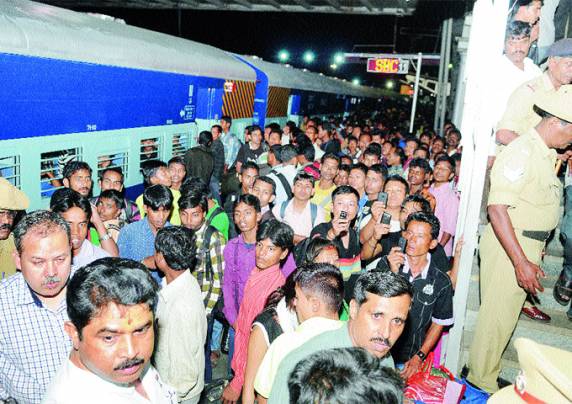
Later on TV channels started airing footages of Bangalore city railway station, which resembled Mumbai VT during the beginning of school vacations. The fact that it happened on an Independence Day evoked memories of those infamous train journeys that happened during the 1947 partition. It left me wondering what was compelling these people to take a chance by travelling ‘sardine’ class for 50-plus hours to reach their hometowns. And I shudder to think as to what shape they are going to be after they reach their destination.

Assurances from state home minister, police officials and others did little to convince them. The state leaders, of course, have a very poor track record in protecting the lives and properties of minorities, hence they carry little conviction. But what actually surprised me was that the state currently has a police chief,  who hails from Mizoram, and even his words inspired little confidence.  

The exodus seems to be cutting across all class lines. As described earlier about that Bihari-Assamese guy, people from every state of northeast, cutting across religion, ethnic and economic strata seemed to be hopping on to the exodus bandwagon. Janitors, restaurant workers, hair stylists, students, techies and BPO employees all seem to have sensed some major unseen calamity was about to befall them if they remained in the city.

For the first time the ethnic strife in Assam between Bodos and Bangladeshi Muslims seem to having fallout in other parts of India. So far all ethnic strife in northeast were very localized events and drew little coverage in the national media. It first began with a protest rally called by a Muslim fringe group in Mumbai turning violent. There were some recent attacks on northeast origin people in Pune and later on a Tibetan in Mysore. These attacks also revealed the opaque perceptions the people from 'mainland' have regarding the communities in northeast.

But somehow all that no way provides answers to Bangalore exodus. Reports of threatening text messages, social networking site messages and inflammatory posters in the city seems to have more than succeeded in triggering this panic. There have been some incidents of stone throwing etc on the city outskirts. The most common rumour doing rounds is that Muslims in the city are waiting for Id to get over to carry out reprisal attacks on people from northeast. Another rumour is that of an inflammatory video on Assam violence is being circulated to incite Muslims. Many among those who were fleeing told newspapers that their parents back home in Assam want them back as they fear attacks in Bangalore. So it looks like there was rumour mongering in Assam also.

Who is behind all these rumours? How they are managing to get the numbers of northeast residents in the city to bombard them with threatening text messages? Why others are not getting these messages? These are early days to get answers to these questions, but needs to be thoroughly investigated. Another scary aspect is that this kind of selective targeting can in future happen with other communities.

When I came to Bangalore six years back what I found very striking was the presence of people from northeast in the city. I guess it was quite a new phenomenon, as during my earlier visit to the city in the nineties, I hardly came across anyone from that region. These new developments seem to be pushing the clock back. I am hoping this is a passing phase and the people who have fled the city will come back.

Also Read: Random Jottings

Friday, 27 July 2012

Commuting On Fast Lane

Hi! We were hailed as red hot beauties when we hit the narrow, potholed roads of Bangalore, teeming with two wheelers and cars. Our sleek low floor design and glassy exterior was a major head turner and many used to gawk at us when our automatic doors used to open and shut with precision at bus stops.

Being used to slow moving and rickety Pushpaks, whose seats are cruder versions of massage chairs, the commuters found us refreshingly fast and futuristic. But our fares - 'ouch', they seemed prohibitive. But later on they were lowered and minimum fare was pegged at Rs 10. This pushed up occupancy and collection.

The patrons started marvelling at the plush seats, air conditioned comfort, electronic display, the public address and FM radio inside the bus.

Many even felt pleasantly surprised that these buses actually had conductors and that too women in many cases. Many of namma city buses have drivers doubling up as conductors. And they spend precious time collecting fares and rummaging the bag for loose change and arguing with passengers. For drivers in Volvo buses there was an added bonus - they no longer had to contend with cumbersome walking stick like gears.

Slowly and steadily the word got around that these upmarket buses were not as expensive as perceived. My peers, who were plying on routes such as ITPL and Electronic City started witnessing a jump in occupancy. During the peak hours the buses on these routes will be full of laptop wielding IT crowd with i-pods plugged to their ears and access cards dangling around their necks.

Though these buses were well received by commuters, their main grouse was that it was not very comfortable for those standing, especially if they happened to be short. Those sudden lunges, induced by the brakes, would often make them wish they were a few inches taller! However I wish to clarify that for those lunges we are not at fault. Our drivers apply our high tech brakes the same way as they used to do with Tata and Ashok Leyland buses.They step on them as if they were trampling a cockroach under their foot.

However, with passage of time the all-pervasive corrosive influence of BMTC have finally caught up with Volvo buses too. Often some of us belch out smoke in no small measure than our desi counterparts, crying for some urgent engine tuning. In some buses the overhanging stirrups meant for the standing passengers either badly need replacement or are missing. In some buses the automatic doors open and shut with a squeal, which almost sound like 'greeease pleease'.

Probably the worst hit is the hi-tech rear view camera display. It enjoyed a pride of place near the driver's seat and commuters used to look at it in wide-eyed excitement as the tiny display screen used to show vehicles in the rear. However, nowadays in most buses it has become dysfunctional and the display screen has been reduced to an empty plastic frame and sometimes even photos of various Hindu deities adorn them. The public address seems to have become a thing of past, though not many seem to be missing it.

When we were introduced in Bangalore, there was not much publicity. In fact, we got eclipsed under shadow of hype over namma metro, and were dubbed as elitist in early days. However, we still succeeded to a good extent in redefining the way Bangaloreans commute. At least we have provided a decent alternative to those travelling on arterial roads.

Also Read: Random Jottings

Sunday, 15 July 2012

Morning Walk Vignettes


The shifting of airport to Devanahalli has freed the approach roads to the HAL Airport from eternal traffic snarls and honkings, and it now resembles one of those sleepy boulevards that Bangalore was once famous for. However, it somehow has not caught the fancy of morning walkers in the area. Probably the stigma of those horrific traffic jams still remains.

I once chanced to come upon this stretch and decided to abandon other trails. The road at the Institute of Aerospace Medicine end and the other one which has the Blue Dart office present a chalk and cheese contrast. The former is well maintained while the latter is unkempt with garbage strewn on the footpath and taxis and lorries parked on both ends. There are even some makeshift eateries and their wafting sambhar smell often aggravates my hunger pangs.

As for the walkers, barring few guys most seem to be the strolling types and are more engrossed with their cell phone, iPods or in conversation with the walking partner.

In most instances it is the husband and wife team and I guess burning calories is the last thing in their minds when they put on the walking shoes. Probably they were following some doctor’s advice with much reluctance. There is one bespectacled guy, mostly in blue t-shirt, who comes solo and seems to be doing what may best be described as a Tai Chi version of jogging.  

There is another guy – a six foot plus, who probably is in the police force or the army. He does some real brisk walking and I must confess I am no match to his pace. A couple of times I did try to catch up with him but his lanky strides were too much for me.

There is one middle aged couple who are quite regular; the man is tall and gaunt with pepper and salt hair, with more of latter. They are serious walkers and do it quite briskly. They seem to be a friendly lot and often nod at me and I nod back out of politeness, all the while wondering who the Dickens they are.

I do come across some women walking their dogs. A middle aged woman with a Dachshund seems to be a regular and sometimes I do see a young woman with a Golden Retriever. The women with Dash often tosses biscuits to stray dogs and even pats them. Probably this is her way of buying peace to prevent her diminutive Dash from becoming their mince meat.

The road is lined with trees and some of them do provide a visual treat when they flower.  The road and the footpath often gets ‘carpeted’ by leaves and flowers, but they don’t remain so for long as the civic workers diligently sweep them away.

Among civic workers I often come across a husband and wife team with their toddler son in tow. Often they take turns to keep an eye on him as they move on with the job of clearing leaves and other wastes.

The trees are abuzz with various birds, mainly crows, and squirrels. One day I happened to come across a squirrel tail on the road, wondering how it got cut asunder. For this gentle looking animal it must have been really painful.

At the erstwhile car park of the airport compound what struck my attention was a Contessa car. I have been seeing it parked ever for too long. Most probably the owner just abandoned the vehicle for a sleeker and less fuel guzzling sedan. He may not have found a buyer or even the scrap guys refused to take it. This rusting jalopy stands in contrast to more contemporary cars parked there.

This luxury offering from the Hindustan Motors’ stable was quite a rage in the late 80s and early 90s, when it had a competition-free ride. Now sighting a Contessa on the road is as rare as sighting a sparrow in our cities.

However, quite recently, to my surprise, I saw the car had disappeared from the parking lot. Often wonder what happened - probably it caught the fancy of some scrap dealer or maybe, at the risk of sounding too optimistic, the owner thought it is worth a makeover.

Apart from the rains, the only spoiler to my morning walks is the 'VIP movement'. Though the aam janta has to trudge all the way to Devanahalli to catch a flight, the netas still use this airport to fly to Delhi. On these days the road at the Institute of Aerospace Medicine end gets cordoned off and police men land up in droves. These stoppages become all the more frequent when there is some political uncertainty in the state and these VIP trips to and from Delhi become all the more frequent.

Also Read: Random Jottings

Tuesday, 13 March 2012

Milking Holy Cow Dry


Few months ago I witnessed a rather curious sight near the Murgeshpalya bus shelter during the morning rush hour. It was drizzling, but no one was willing to take refuge inside the shelter - some were taking a chance by exposing themselves to the drizzle, while others had unfurled their umbrellas or put on the hoods of their jackets. From a distance it seemed ridiculous to me, but as I came closer I realised their seemingly foolish act was probably the most pragmatic option under those circumstances.

The shelter was 'occupied' by some 3-4 cows and some of them were merrily carrying  out their morning ablutions, quite unmindful of the 'sick hurry and divided aims' (apology to Matthew Arnold) of two-legged denizens. The bus stand is located close to a vacant area (read unofficial garbage dump) and hence for cows it was a favourite haunt, come rain or sunshine.

Like any city in India Bangalore has a substantial presence of cows, though in terms of numbers it may not be a match to cities located in country's 'cow belt'. For most owners their holy cow act ends after they have milked them to their last drop in the morning. After that our four-legged friends are left to fend for themselves till night. With alarming drop in city's cover of gomal (grazing) land, thanks to the rapacious builder-politician nexus, cows have to make do with garbage heaps and vegetable markets to keep their body and soul together.  

I often come across vegetable vendors, quite literally, go bananas trying fob them off as they make a dash for green vegetables or overhanging plantains. Quite often these cows court health hazard by eating things like plastic bags and paper. The city's civic authorities have passed laws against stray cattle menace, but they are not even worth the paper these cattle chomp and regurgitate on a daily basis.

Though cows are too docile to be a menace like dogs, but they do end up dirtying public places and sometimes also cause traffic snarls. Their sheer size and languid demeanour often comes in the way of ever increasing traffic flow on the city roads. It's not an uncommon sight to see them happily lounging in the middle of the road and shooing away flies using their tails or flapping their ears; while they take motorists' desperate honking as if it were happening in some other planet. Traffic policemen shoo them away using lathis and they reluctantly get up and amble off in a speed that is comparable to Indian Railway's IRCTC website.

Once a former colleague of mine told me that she was waiting at a bus stop and talking on phone. Suddenly out of blue she experienced a jet of hot air on her neck. Startled she looked back to see the nostrils of a cow in close proximity. She quickly moved away as she was unknowingly blocking gau mata's path.

Their exalted place in the Hindu mythology keeps the general public from rubbing them the wrong way, but their owners seem to have little concern about their welfare and that too totally evaporates once they fall sick or past their milk yielding age.

Also Read: Random Jottings

Saturday, 25 February 2012

Mockery of Fire Drill

We have heard all this before - that life is cheap in India, disaster management is not at all a priority for our society. And Bangalore is no exception to all this. Two years back the Carlton fire tragedy exposed how safety measures were sacrificed by the builder at the altar of greed, and how officials winked and signed all the dotted lines - again for a price. It was often said that we as a nation are least bothered about safety measures.

Look at Japan, we were told, how well they cope with disasters. They conduct regular drills and that is why they are able to do all that. When Carlton became a national TV spectacle, with people jumping off from the building in panic, the need for fire drills gained currency.

But what happened on February 24, 2012, almost exactly two years after the Carlton tragedy (it happened on February 23, 2010) reveals that we are ill-equipped even to carry out such drills, leave alone dealing with the actual tragedy. Maybe the organisers need to go on 'phoren' tour to learn all this.

A fire drill at a readymade garment factory in the Yeshwanthpur industrial suburbs went haywire causing the death of a woman employee. As per the drill, the employees were asked to use a rope to climb down from the fourth storey. She was the second person to do so and in the midway the rope snapped and the rest was history.

Several disturbing questions come to my mind. Firstly was it necessary that the employees had to risk their lives by climbing down from fourth floor and that too without a safety net. Forget snapping of rope, what about people with dizziness and fear of heights, won't they panic? Couldn't they have used a dummy to demonstrate it.

Climbing down a rope is no joke. Military personnel practice for months to master it. Maybe, they thought garment factory workers were Supermen and Spiderman by default!

There are also reports that the rope used was an old one and of poor quality. Not only that some had raised objections regarding the rope, but the fire department officials chose to ignore it. Anyhow now no amount of debating or inquiries would bring any solace to the woman's near and dear ones.

In my previous office we used to have fire drills carried out by one private agency, but we never had to do such risky stunts. In fact, it was the other extreme, they used to be hilarious affairs. A Colonel Blimp type guy used to take centre stage and, quite literally, bark on the microphone and some of his assistants and office volunteers (ostensibly named Emergency Response Team) used to do a demo on how to carry out rescue act.

He used to pick up volunteers for 'fire victims' randomly from the audience and used to address each one of them with film star names. "Hey Madhuri Dixit, come here?" or "hey Salman Khan don't hide behind the red shirt guy, come to the stage?"

I still recall him telling one woman 'victim' volunteer, "Don't think 'oh I am a woman, how can these men hold me'." and turning to the volunteers he said, "You should promise that you would see her as your sister and nothing else." It used to be quite tough to keep a straight face. 

And 'backbenchers' like me used to slip off to the nearest food court in our office campus. In fact these drills used to 'fire up' sales at the food court and bunk shops located outside the campus. That of course shows the other very typical Indian mindset - "Nothing will happen to me".

Also Read: Random Jottings

Saturday, 18 February 2012

Warming winters

While watching NDTV 24x7 my attention often gets drawn to the running ticker below showing live temperatures of various cities in the country. And often I feel quite alarmed on seeing Bangalore's temperature, which seems always on the higher side during winters. Quite often it is even higher than Mumbai, which has more of a tropical coastal weather.
 

This winter was rather freakish all over India, with temperatures falling below the usual levels and places like Dehra Dun even experiencing snowfall - something that had never happened in that hill station for decades. But alas, no such pleasant surprises for Bangaloreans. Here whatever little cool breeze we experience in the winter mornings vanish with the early rays of sunshine. After that the scorching sun takes centrestage and then it is little different from April-May, and we wait for sunset for some relief. Sweater, jackets seem redundant (unless you are riding a bike) or more of a fashion statement.
 

The other day I read a news report that average temperature in the city was rising at a faster rate than other places. Scientists claim that while the temperatures world wide rose by one degree in 100 years, in the Garden City it did so by two degrees. It is a startling finding and I feel the days of 40-plus degree centigrade summers is round the corner. Experts says all this is due to massive urbanisation following the IT boom.
 

The city seems to be broadly suffering from two sets of problems - one that every city undergoing rapid urbanisation is afflicted with and the other due to the city's peculiar characteristics such as topography, climate. The city's bewildering pace of urbanisation had caught everyone off guard. The results have been dwindling tree cover and an exponential increase in concrete structures. Even trees on footpaths seem to be weakening with roots getting choked by masonary and leaves are getting exposed to fumes from ever increasing vehicular population.
 

The city's burgeoning population has put its lakes under stress. Many of them either got vanished to carry out 'development' and some have been reduced to overgrown drains to dump effluents. Some of the city's landmarks such as Kempegowda bus station, Kanteerva stadium and National Dairy Research Institute are actually situated on lake lands. Guess, those days environment was not a strong constituency and these measures may have had the blessings of the people.

The city is actually staring at a major water crisis and if nothing timely is done to preserve the depleting water table, the problem would only worsen. Moreover since the city is located on a plateau, its ecology is all the more fragile.
 

Frankly I see not much remedial measures happening. The city fathers have raised the pitch for rain water harvesting, but it has a long gestation period. Surprisingly not much is being talked about  water recycling. The government should get proactive and set up recycling plants in all wards to collect waste water for recycling. It should make it mandatory that only recycled water should be used for industrial purposes. And also in bathrooms and for activities like washing cars, gardening etc. The situation calls for really drastic measures.
As a passing thought I often see water lorries spilling around water as the move on the road. Something needs to be done to curb this criminal waste.

Also Read: Random Jottings